Being Good At The Job Is Never The Whole Job
The Signal and Substance Matrix and why the best person in the room keeps getting overlooked.
Somewhere in your career, I know you have watched this happen. The person who talks the most gets promoted over the person who does the most. The room nods along to someone with a confident voice and a thin grasp of the detail, while the person who actually carried the project sits quietly in the corner, assuming the work will speak for itself.
Unfortunately, it does not speak for itself and it really never has.
I learned this the slow way across fifteen years in corporate law and I watched a lot of genuinely brilliant people learn it the hard way, usually at promotion time, just one beat too late.
Being good at the job and being seen to be good at the job are two completely different skills. Most of us were sold the first one as if it were the whole deal.
It is not. It is half.
So, I built a map of it
Two axes.
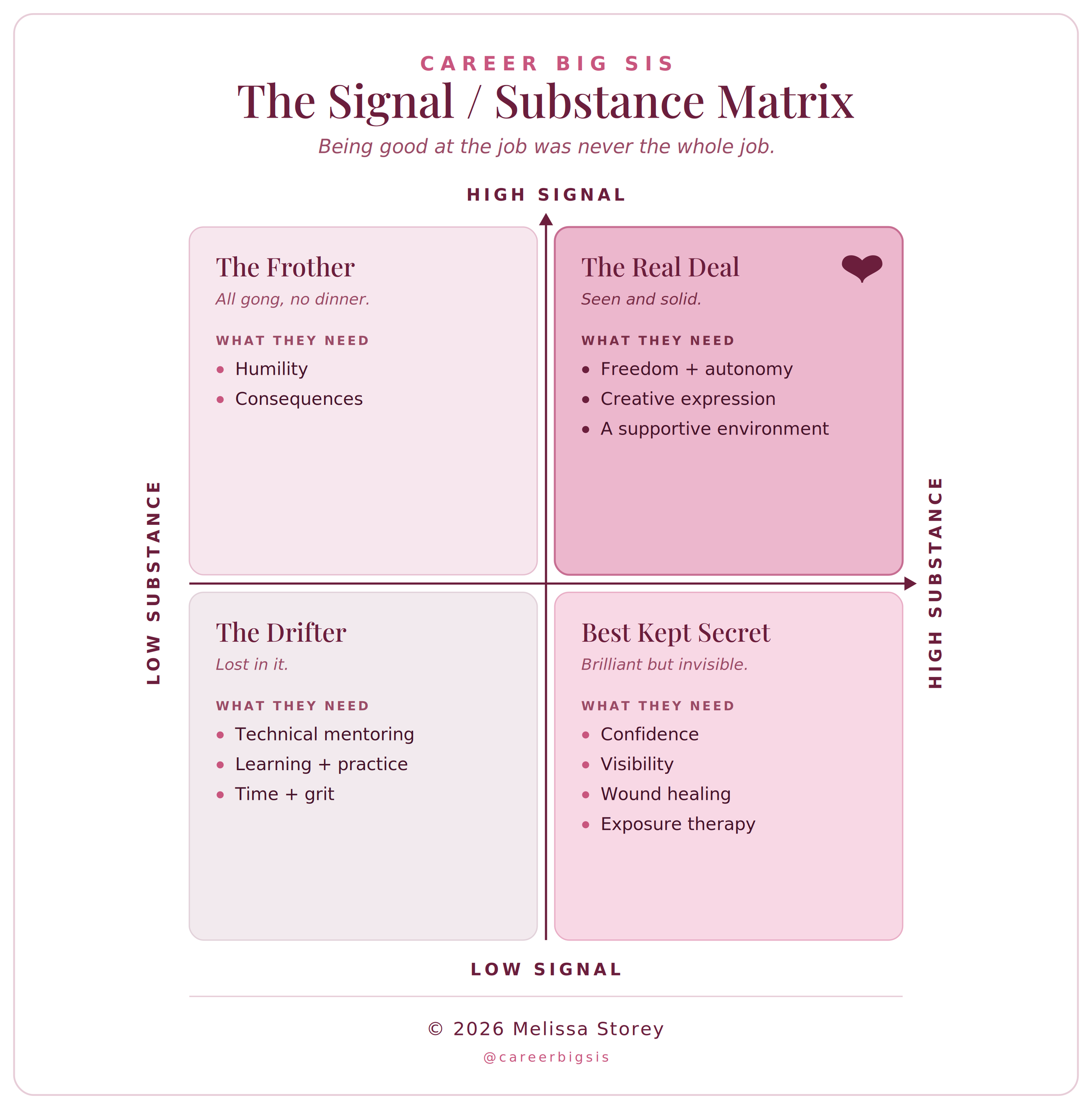
Substance runs along the bottom. That is the real thing. Are you actually good. Can you do the work, hold the risk, make the call when it matters.
Signal runs up the side. That is whether anyone knows. How well you perform the competence you have, how legible your work is to the people who decide your future.
Cross them and you get four types of people. You and I have been all of them at some point and you are probably standing in one of them right now.
The Real Deal
High substance x high signal.
The sweet spot and yes it gets the heart. Good at the thing, and the right people know it. Their reputation is just an accurate summary of their work with nothing inflated and nothing hidden. This is who gets the brief, the referral, the keynote and the promotion that nobody around them questions or resents.
This quadrant is earned, not performed into being. You do not bluff your way here. You build here by closing the gap between what you can do and what people can see.
What they need: freedom, autonomy, room for creative expression and an environment that actually backs them. Real Deals do not need managing so much as they need to be left alone with enough trust and air to do the thing. Micromanage one and you will lose them.
The Frother
High signal x slow substance.
Your bullshit artist, with a more Australian ring to it. All gong, no dinner. The Frother rises fast, because most workplaces reward the loudest voice in the room well before they reward the best work in the room.
The catch here is usually time. The gap between the froth and the goods only ever closes one way and it closes on them. Short-term winner, medium-term liability. We have all watched a Frother get found out, usually the moment something actually goes wrong and there is no substance underneath to hold it.
What they need: humility and consequences. Not cruelty. A Frother who gets a genuine reality check early, before the stakes are high, can develop into a real deal. A Frother who never faces a consequence just keeps getting promoted until they are running something important on vibes alone.
We have all met that person and we have all cleaned up after that person.
The Best Kept Secret
High substance x low signal.
The humble underdog and the most heartbreaking square on the board. This quadrant is full of genuinely excellent people who believe, sincerely, that the work should speak for itself. Cute.
But, it will not. Being a secret is not a virtue, it is a career risk dressed up as modesty. These are the people who get passed over while a Frother leapfrogs them, and that exact moment, the overlooked-again moment, is what quietly turns good people cynical. It is where burnout starts and it is where the best lawyers I know started planning their exit.
The fix is not to become a Frother. Please do not become a Frother. The fix is to keep the substance and build the signal.
What they need: confidence, a bit of visibility wound healing and some exposure therapy. Because for most Best Kept Secrets the reluctance to be visible is not strategy, it is a wound. Somewhere along the way they learned that taking up space was dangerous or arrogant or unbecoming. Visibility feels like a risk rather than a skill. The work here is as much about unlearning that as it is about a better LinkedIn presence.
It is uncomfortable but necessary work and it does not mean loosing who you are and what makes you you in the process.
Remember that confidence is not arrogance if you have self-awareness (which you do).
The Drifter
Low substance x low signal.
The danger zone, with one big caveat, because two very different people live here.
The first is the genuine beginner who simply has not built anything yet. That is completely fine. Everyone starts in this corner and passes straight through it. A graduate is a Drifter by definition and there is no shame in it.
The second is the comfortable coaster who stopped growing some years ago and nobody has noticed. That one is the actual danger.
What they need: technical mentoring, real learning and deliberate practice and time plus grit. The beginner needs someone to actually teach them, which is exactly the thing most legal institutions forget to do well.
The coaster needs honesty and a reason to move. Neither needs a personal brand or internal stakeholder heatmap strategy yet. Substance comes first. You cannot signal a competence you have not built, and if you try, congratulations, you have become a Frother.
Now, about law…
Here is where it gets personal for our profession, because law is uniquely good at rewarding the wrong quadrant.
Law looooves a Frother.
Confident, polished, billed plenty of hours, said the partner-pleasing thing in the meeting. The whole apparatus is built to reward visible confidence and is genuinely bad at noticing the quiet person who actually understood the deal.
At the same time law manufactures Drifters and then abandons them.
We take graduates, drop them in the deep end, call it earning your stripes and rebrand the absence of training as some sort of twisted rite of passage. The technical mentoring that would turn a beginner into a Real Deal is the first thing cut when everyone is busy, which is always.
We trained a generation for a version of the job that is already shifting under them, then act surprised when they cannot find solid ground.
Then there are the Best Kept Secrets. Law is full of them, disproportionately women, disproportionately the people who were raised to believe that good girls do the work and do not make a fuss about it.
They are the safest pair of hands in the building and the last to get the title.
If you lead people, this is a tool not a mirror
This map is not just for looking at yourself. Put your team on it.
Then read the "what they need" column properly, because the single most useful thing about this framework is that every quadrant needs something different and most leaders give everyone the same thing.
Do not promote on signal alone. The loudest person is not automatically the best person, and every time you reward froth over substance you teach your quiet brilliant people that the game is rigged, which is the fastest way to lose them.
Go and find your Best Kept Secrets. They will not put their hand up. That is the whole problem. Naming someone's competence out loud, in the room, in front of the people who matter, is one of the most powerful and least expensive things a leader can do.
This is what I mean when I bang on about leading differently and actually developing your people rather than just inheriting whoever happens to survive the system.
What if the secret is you?
If you have read this far and quietly recognised yourself as the Best Kept Secret, here is the big sis bit, just for you.
Being good was never the whole job. Performing competence is not the same as faking it. It is just making your real work legible to the people who decide what happens to your career. If you are good and nobody knows, you are not being humble. You are being invisible and invisible does not get promoted, does not get the brief and certainly does not get the pay rise you have earned three times over.
You do not have to become loud but you have to become legible.
There is a world of difference and it is learnable.
Mel
Want to do the deeper work?
Two ways in:
If this is about you. If you know which quadrant you are standing in and you want help moving, a 1:1 session is where we do the real work. We map where you are, find the gap between your substance and your signal and build you an actual plan to close it. Book a 1:1 session here.
If this is about your people. I run workshops and speaking sessions on signal and substance, visibility and developing talent, for teams and leadership groups who want to stop losing their quiet brilliant ones. Enquire about a workshop or a speaking gig for your team or leaders here.