Big Sis Briefing: When 37 AI Prompts Created Art (And Nobody Could Agree If That’s Legal)
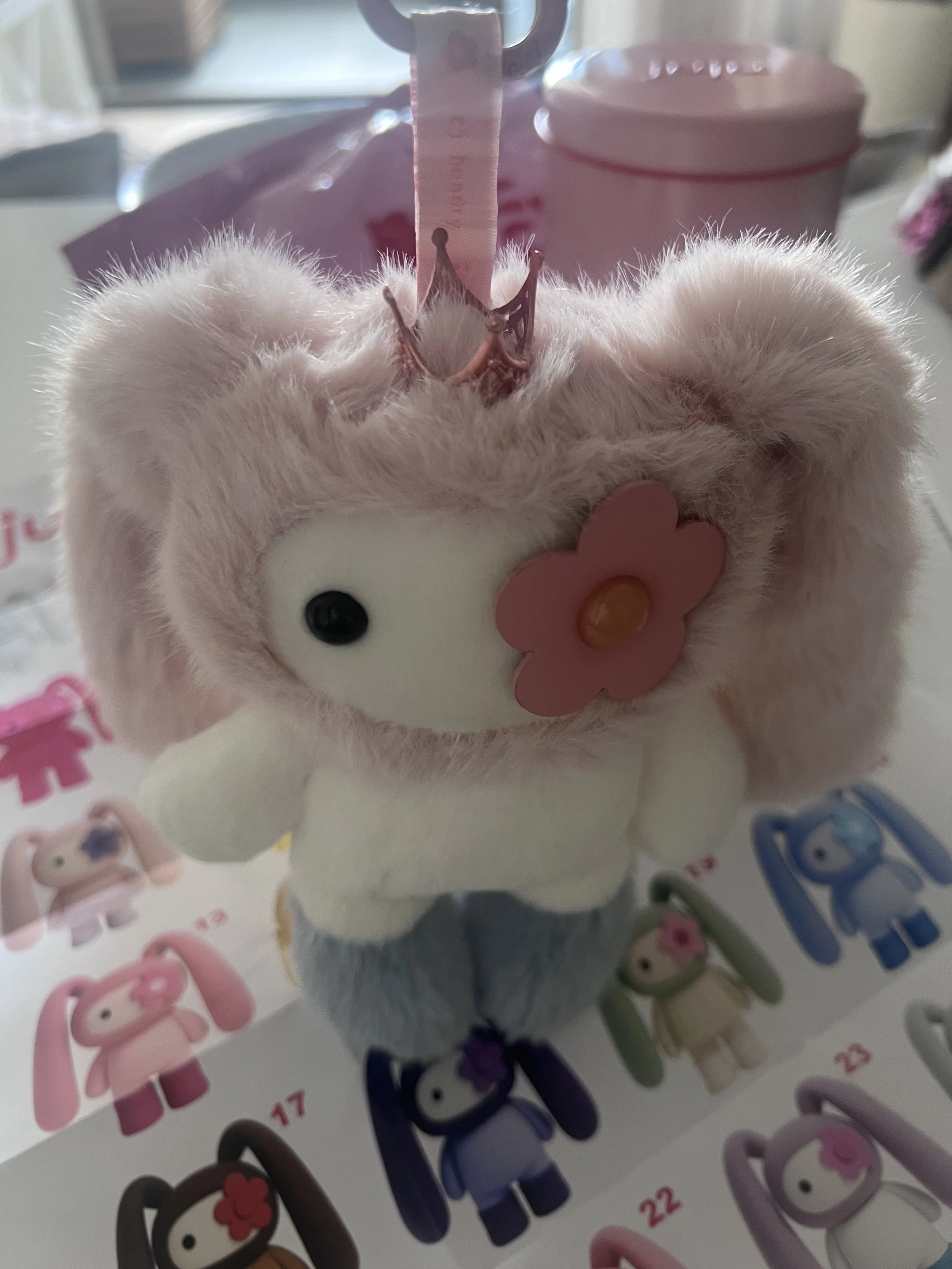
My JuJu arrived this week.
She’s sitting on my desk right now. Long floppy ears, a flower patch over one eye, the softest little presence. She came in a blind box from Brisbane-born, New York-based artist CJ Hendry’s latest project and I’m completely (bag) charmed.
But JuJu’s origin story has sparked something I can’t stop thinking about. The line between inspiration and infringement. The moment an AI prompt becomes a work. What we even mean by “original” anymore.
Also why, in the middle of legal chaos and uncertainty, we’re collectively losing our minds over cute collectibles in the first place.
37 prompts and a copyright controversy
CJ Hendry didn’t draw JuJu from her imagination alone. She fed images into ChatGPT. A few different cute plush toys, including Labubu (the PopMart sensation that’s had everyone from Lisa of Blackpink to your local politicians carrying them as bag charms). She asked the AI to create something that was a mixture of three of them. Then she iterated. Longer ears. Flower patch over one eye. Something like 37 prompts later, JuJu emerged in her final form!
Then CJ did what she does best.
She took that AI-generated concept and made it real. Drew it in her signature hyperrealist style (the kind that looks like a photograph but isn’t). Had plush toys manufactured and created a whole universe around the character. Launched it as blind boxes for shipping around the world. Built community, art and commerce around a figure that started as AI output.
The controversy on her Instagram account was immediate. People questioning whether this was “real” art. Whether using AI to generate the design crossed some line. At what point the iterations made it hers. Was it the first prompt? The fifth deviation? The final 37th?
Where exactly does inspiration end and theft begin when you’re working with AI trained on other creators’ work?
The legal landscape is a mess (and that’s putting it kindly)
The timing of JuJu’s arrival couldn’t be more perfect for examining where we are with AI and copyright. Because right now, the legal world is trying to draw lines in constantly shifting sand.
Just this week, Disney announced a $1 billion investment in OpenAI and a licensing deal that will let users generate videos of Mickey Mouse, Elsa, Darth Vader and 200+ other characters through Sora. Users will be able to create short AI-generated videos featuring these characters starting in early 2026 (dear lord who will protect poor Mickey from some sordid behaviour now).
This is the same Disney that simultaneously sent a cease-and-desist letter to Google for using Disney IP to train AI models without permission.
The same Disney that’s suing AI image generator Midjourney for copyright infringement.
I saw that the Writers Guild of America immediately called the OpenAI deal an apparent sanctioning of “theft of our work”.
Disney is both aggressively protecting its IP and actively licensing it for AI generation. They’re fighting unauthorised use while embracing authorised use. They’re playing both sides because nobody actually knows how this is going to shake out.
The music industry is going through the same convulsions. Universal, Sony and Warner sued AI music generators Suno and Udio for training their models on copyrighted recordings without permission. Then in November, Warner settled with Udio and will partner on a licensed AI music platform launching in 2026. Universal is reportedly in similar talks.
The pattern is clear. Initial lawsuits. Aggressive IP protection. Then licensing deals that legitimise the very thing they were suing over. Not because these companies suddenly love AI but because resistance might be less effective than collaboration when the technology exists regardless.
In March 2025, a US Court of Appeal ruled that works created entirely by AI cannot be copyrighted. They lack human authorship. But works where humans use AI as a tool, where there’s “sufficient human input”, can potentially be protected. The question nobody can definitively answer yet is what counts as “sufficient”.
Is 37 prompts sufficient?
Is drawing the AI output sufficient?
Is manufacturing it into physical objects sufficient?
This isn’t new (we just keep forgetting the pattern)
We’ve been here before.
When Napster made music infinitely copyable, the industry sued everyone. Then they adapted. Streaming services emerged. Artists got paid differently. The music didn’t stop being valuable, we just had to rethink what ownership meant.
Sampling in hip-hop went through this exact evolution. Initially controversial, potentially illegal, eventually a defining element of the genre with established licensing frameworks.
When a human samples, they make conscious choices about meaning and context. When AI samples, it’s pattern recognition and statistical recombination. The distinction matters for both legal frameworks and cultural preservation but the adaptation process sure does look familiar.
What’s different with AI is the scale and speed though.
Napster let you copy one song at a time.
AI can absorb millions of works simultaneously to generate infinite variations. The traditional frameworks of copyright were built for scarcity. They assumed copying required effort. They expected human decision-making at every step.
AI breaks all those assumptions completely.
CJ Hendry has always understood this tension
CJ is no stranger to the weird space between inspiration, appropriation and infringement.
In 2018, she created hyperrealist drawings of Andy Warhol Polaroids (celebrities like Muhammad Ali, Mick Jagger) and then drew them crumpled up, printed them on t-shirts and planned to sell them in Campbell’s soup-style cans as an homage to Warhol. I watched the entire process unfold online.
Then, just a few hours before the launch, she received a cease and desist letter from the Ali estate. Even though she’d drawn everything by hand, even though it was layers of transformation, she was told selling them would risk legal action.
Her response was peak ✨Australian✨.
She said “f*ck it, we’ve already spent $20,000, let’s at least have some fun.”
So, she packed the t-shirts in bright red boxes labeled “Copyright Infringement Trash Only” and turned it into a scavenger hunt. She dropped boxes around New York, posted locations on Instagram and watched her followers sprint through the streets to claim them.
It became an annual global event (one I participated in twice without any luck). Then, came a documentary. It was a brand-building exercise that generated more goodwill and community than selling the shirts ever would have.
She turned a legal reality into a creative opportunity. She didn’t fight the system, she danced the nutbush around it. She found a way to share the work, build community and avoid infringement all at once.
It’s that Australian sensibility of not taking all this sh*t so seriously while still respecting (or at least not openly violating) others’ legal rights.
With JuJu, I think she is doing something similar.
Using AI as a tool but certainly not hiding it.
Acknowledging the inspiration (Labubu and others) without pretending she invented cute plush toys from scratch.
Adding enough of her own creative input through the prompting process, the artistic rendering, the physical production and the brand universe that it becomes something new. Something hers.
Whether it’s legally protected is genuinely unclear. Whether it should be is a reasonable debate. But she’s creating it anyway and letting the conversation happen around it.
Meanwhile, we just want to feel something now
Here’s what I find low key fascinating.
While lawyers, artists and tech companies fight about who owns what and what counts as creation, the market is giving its own answer.
People are buying JuJu. They’re collecting Labubu (PopMart’s stock surged 270% this year before recent volatility). They’re obsessed with blind boxes, limited editions and tiny collectibles that serve no practical purpose.
Us Millennials are diving headfirst into this. Pokemon cards. Blind box toys. Collectible bag charms. Things that tap into nostalgia for a time when life felt simpler and we didn’t all exist online.
CJ has locked into the core elements of this cultural moment. Nostalgia. Collectibility. The blind box format creating artificial scarcity and the thrill of the chase. Rarities and variations that drive completion behavior. Community around shared obsession.
It’s the same psychology that drove trading cards when we were kids, except now we’re adults with disposable income, a lot of corporate pressure to ✨increase shareholder value✨ and maybe we just want a cute thing that makes us feel something uncomplicated for a minute or two.
The brands that understand this are building incredible loyalty. Limited edition drops. Collaborations that feel special. Physical objects in an increasingly digital world. The ability to hold something, display something, collect something that represents participation in a community.
I’m watching this closely for my own work. Limited edition guides. Stickers. Merch that signals belonging to the emerging Career Big Sis ecosystem. Not because I’m trying to become PopMart but because I’m recognising that people want tangible connection to the work that resonates with them.
We are all craving community and the resulting status symbols that connect us to like-minded humans in the real world.
What this means for other creators
We’re in a weird in-between moment.
The old rules don’t quite work. The new rules don’t exist yet. The institutions that own the most valuable IP are both suing AI companies and partnering with them. Courts are trying to apply century-old frameworks to technology that makes those frameworks look quaint.
As creators, we’re all navigating this to different degrees.
Whether you’re using AI to draft contracts, generate images or formulate ideas, you’re participating in this shift whether you planned to or not.
The practical reality is this: if you create something entirely with AI, you probably can’t copyright it. If you use AI as a tool within a larger creative process that involves “substantial(?)” human input, you might be able to.
If you’re using AI trained on copyrighted material, you might face lawsuits (or the companies providing the AI might face them) though eventually I suspect there will be licensing frameworks that legitimise it all.
Nobody knows for certain yet.
The law is being written in real time through litigation, settlements and legislative attempts that can’t keep up with technological development.
I say we should take a leaf out of CJ’s book and just create magic anyway.
✨ Be transparent about your process.
✨ Respect others’ IP when you can.
✨ Understand you’re operating in legal ambiguity.
✨ Add genuine human creativity and judgment to whatever tools you’re using.
✨ Build community around the work.
✨ Don’t wait for perfect clarity because it’s not coming anytime soon.
Maybe also remember that sometimes the most interesting work comes from nutbushing in uncertain spaces.
From taking legal constraints and turning them into creative opportunities. From understanding that inspiration has always borrowed, built upon existing and then transformed, we’re just doing it with new tools now.
CJ Hendry made 37 iterations to get to JuJu.
That’s not just prompting, that’s creative direction. She then drew it, manufactured it and built a universe around it.
At some point in that process, it became hers. Or maybe it was always a collaboration between her vision and AI’s capabilities, the influences she fed in, the manufacturing process and the community that embraced it.
Ownership in the age of AI might be less about bright lines and more about layers of contribution.
JuJu sits on my desk right now, flower over one eye, and I’m not thinking about who owns what. I’m just enjoying the thing. Which might be the most honest response to all of this.
Create what you want to create. Use the tools available to you. Respect the work of others. Add your own vision, judgment and taste. Let the lawyers sort out the details while you’re building something that matters to people.
If you can make it cute, collectible and tap into our collective desire for simpler times, even better!
Onwards
Mel
💖