Rare for Some Is Not the Same as Right For You
On energy, edge and the quadrant I keep sending myself back to, from private practice to in-house to running my own business.
I am writing this from a coffee shop in New York with a cortado (the closest drink to a piccolo here), a notebook and, for the first time in a while, nothing urgent to do.
It is always in these pockets of space that the things that have been swirling around my brain for weeks finally come in to land.
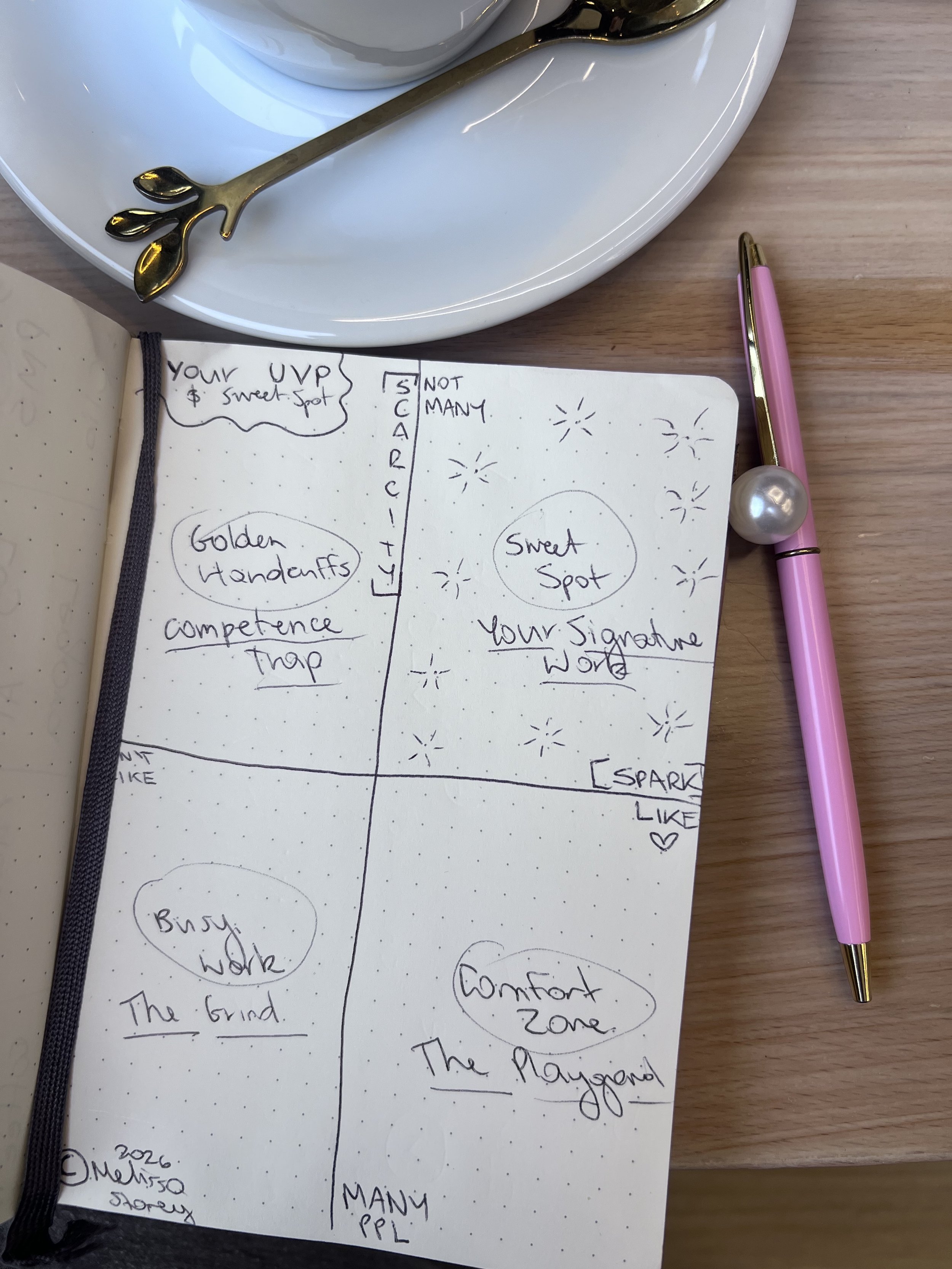
True to form, my brain landed them as a quadrant. If you were here for The Career Clarity x Capacity Matrix, you already know this is simply how I think now and I have made my peace with it.
This one is about your unique value proposition, which is a fairly corporate phrase for a very human question: what is the work only you can do and does it actually light you up when you do it?
(See scribbled quadrant image at the bottom of this piece).
The two axes
Across the bottom runs Energy. On the left sits the work that drains you, the tasks you procrastinate on, dread on a Sunday night or finish feeling like a wrung out Country Road tea towel.
On the right sits the work that fuels you, where time disappears and you come out the other side with more in the tank than you went in with. I deliberately did not call this axis "what you like", because plenty of lawyers like things that still flatten them and energy is the more honest test.
Up the side runs Edge. At the bottom is the work many people can do. At the top is the work very few people can do or at least very few can do quite the way you do it.
Most lawyers undersell their edge because they only count what is on the practising certificate. The rarest skills are often the ones nobody thought to put in a position description.
A few that rarely get counted:
How you communicate
Drafting advice with legal design principles, so it gets read and acted on rather than archived
Turning a 20 page memo into a one page answer a board or CEO will actually read
Translating legal risk into the language of sales, finance or product
Making complex things visual with flowcharts, decision trees and one page explainers
Running training sessions that the business enjoys and remembers
How you think commercially
Spotting the issue nobody asked about before it becomes the problem everyone is asking about
Reading financials, a cap table or a pricing model without breaking a sweat
Knowing when good enough is good enough and saying so with confidence
How you build systems
Building templates, playbooks and precedents other people rely on
Project managing a deal or matter with a dozen moving parts and keeping everyone on time
Being fluent with legal tech and AI tools while the rest of the team is still hesitant
Fixing a broken process so the same question stops landing on your desk
How you work with people
Being the person clients call before a decision rather than after it
Calming a stressed stakeholder or keeping your head in a crisis
Running a negotiation where both sides leave feeling heard (tricky!)
Knowing exactly who to ask across the business to get something unstuck
Mentoring juniors so they get better faster and not feeling threatened by that
What you bring from outside law
Deep industry knowledge from a previous career in nursing, engineering, hospitality, music or tech
A second language or cultural fluency that matches a client base
Lived experience such as being first in family, regional or a career changer, which lets you connect with people the profession usually misses
Writing publicly or building a professional brand when most lawyers still will not post
Credit where it is due, if you have read Gay Hendricks' The Big Leap you will recognise some of the bones here. His Zone of Excellence, the work you are brilliant at but do not love, is a close cousin of one of my squares.
What I have done is pull the rarity question out into its own axis, because in law rarity is the thing that gets rewarded, which is exactly where so many of us get stuck.
The Grind
Low energy x low edge.
This is the work that drains you and that, if we are being honest, plenty of other people could do. Every career has some of it and there is no shame in that. My early years in private practice had their fair share cough due diligence contract review cough.
I did it, I learned from it and some of it built judgement that I still use. The trouble starts when we wear The Grind as a badge of honour, because the profession has spent a very long time telling junior lawyers that suffering through it is the same thing as being good at it.
It followed me into business too. Inbox, invoicing, chasing payments, formatting the same Instagram carousel for the fourth time. For most of my first year running Counsel Media full time I did all of it myself, partly because I could not yet afford not to and partly because I had not noticed how much of my week it was quietly eating.
What to do with it: systematise it, delegate it, automate it or trade it away as soon as you are able. Until then, batch it so it stops leaking into the hours where you do your best work.
The Playground
High energy x low edge.
The fun square!
Work you genuinely enjoy and come away buzzing from, which plenty of other people could also do. Early career lawyers often mistake this square for their niche, because enjoyment feels like a signal. It is one but just not the whole signal.
My version as a business owner is tinkering with designs in Canva, editing the podcast or building systems in Notion. I could happily lose a whole afternoon to it and I have.
None of that is a crime. The Playground is where a lot of joy lives and you should keep some of it in your week on purpose. It only becomes a problem when it fills the hours that belong to the work only you can do, because enjoyable and busy can feel an awful lot like productive.
What to do with it: keep it, ring fence it and enjoy it, just stop mistaking it for your value proposition. If someone else can do it well and you can afford to hand it over, the hours you get back are worth far more in the top right.
The Competence Trap
Low energy x high edge.
The most dangerous square on the board, which I have lived in more than once, for more years than I’d care to think about for fear of shedding a tear. Into my Cortado.
This is the work you are genuinely excellent at, that not many people can do but which drains you every single time you do it in ways you no longer notice anymore.
It is a trap because the legal profession is built to reward edge and is almost completely blind to the energy that is takes.
Be rare at something and you will be given more of it.
Be rare enough and you will be promoted for it, which means more of it again, now with a bigger title and a reporting line attached.
Nobody in a performance review ever asked me whether a piece of work gave me energy. They asked whether it was done.
I went in-house early, back when it was still seen as stepping off the ladder rather than climbing a different one and over fifteen years I worked my way up.
Along the way I became very good at certain things. I was valued for it, paid well for it and quietly flattened by it. Because it was rare and rewarded, it took me far too long to recognise it as a trap at all.
The business version caught me too. In my first year full time I ran roughly fourteen income streams, mostly to gather data on what actually worked. A lot of them I could do well and not many people could, which made it very easy to keep saying yes. Edge is very persuasive when you are watching the bank balance.
This square is also where scarcity thinking does its best work. If you believe there is only one narrow path in law, one cupcake rather than a whole bakery, you will cling to the thing that is safe and paying long after it has started costing you more than it gives.
What to do with it: respect it, because the skill is real and it has value, then start deliberately shrinking it. Teach it, document it, price it higher, hand it to someone for whom it would be Signature Work or keep it as a paid sideline rather than your whole week. Watch for it creeping back in every time someone tells you that you are just so good at this.
Signature Work
High energy x high edge.
Now this, this right here, is the sweet spot.
Work only you can do quite like this, which gives back more than it takes. You come out the other side tired but in the good way, the way you feel after a great conversation rather than a long meeting.
For me it is the moment in a Career Clarity session when somebody's tangled, half formed career thinking clicks into a shape they can actually see and act on.
Leading someone through that maze and holding space while they have a well overdue ‘a-ha’ moment is the stuff of real joy. I sometimes want to weep and they often do.
The ‘unlock’ is palpable.
It is also, clearly, turning what my community tells me into frameworks like this one. I can do that for hours without needing to psych myself up for it and it is the part of my week I would keep if everything else were stripped away.
Signature Work is not a destination you reach and then stay put. The other three squares are constantly trying to reclaim the territory. Inboxes grow, rare skills attract requests, fun tasks expand to fill whatever time you give them. Staying here is ongoing maintenance rather than a one off decision.
What to do with it: protect it like the most valuable thing in your calendar, because it is. Build your week around it first and fit everything else in after.
Why law makes this so hard
Our profession is very good at measuring edge and very unskilled at noticing energy.
Billable targets, practice group rankings and the promotion pipeline are all designed to find the thing you are rare at and extract as much of it as possible. That is a perfectly sensible business model for a firm. It is a terrible career strategy for a human being over the long term, because a career built only on edge lands in The Competence Trap almost by default.
The other thing nobody tells you is that your quadrants move. What was Signature Work three years after admission can become The Competence Trap at ten, while something that used to drain you can start to energise you once you have the confidence or the context. I have fallen into every one of these squares as a lawyer and again as a business owner, and I fully expect to keep doing it.
The point is not to land in the top right once and stay there. That would be too easy.
It is to keep noticing when you have drifted and steer yourself back. If you are earlier on and still working out direction at all, The Scenic Route Is Still a Route is a good companion read.
How to map your own
Pick a normal fortnight, not a holiday week and not the week a deal closes. Write down everything you spend real time on. If you keep time records they are a gift here. If you do not, your calendar and your sent folder will tell you most of what you need.
Then run every item through two sets of questions.
On energy
After doing this, do I have more in the tank or less?
Do I put it off, or do I find excuses to get to it early?
When I am doing it, does time drag or disappear?
If nobody was watching or paying, would I still choose some version of this?
On edge
How many people in my team, firm or market could do this as well as I can?
Do people seek me out for this specifically, or would anyone competent do?
If I disappeared tomorrow, how hard would this be to replace?
Is this rare because of my skill and perspective, or only because nobody else has been asked?
Plot each item on the quadrant. Rough is fine, because the pattern matters far more than the precision.
Then look for:
where most of your hours actually sit, as opposed to where you assume they do
what is hiding in The Competence Trap that you have been calling a strength
one thing in the top right you could make more room for this quarter
one thing from the bottom row you could hand over to make that room
One move a quarter is plenty. This is a slow redesign of your weeks and it takes time.
If you want to go deeper
If you would like somewhere structured to do this thinking, the Lawyer Reset Journal was made for exactly this kind of pause, the space where the swirling things finally come in to land.
If you would rather do it out loud with someone in your corner, book a Career Clarity session.
In the interests of practicing what I preach, I will tell you plainly that these sessions are my Signature Work. We spend 45 minutes untangling where you are and where you could go, you leave with a personalised action plan and I come out of every one with more energy than I went in with. Which, as it turns out, is the whole point of the quadrant.
Onwards!
Mel
💖